Why does it take someone 50 years to get back to their roots? I mean really, literal roots. Actually, I guess it was more like 30 years ago, when I was growing up, we raised a mighty-big garden for a few years...then, ever-after, nothing but a house plant now and then.
Underneath it all, behind the suit, tie and designer glasses, I'm just a country boy at heart. My values are much more consistent with Mother Earth News than Mother Jones. I have deep respect for sustainability and independence and all-things-natural...so why have I been so dreadfully disconnected?
This summer will mark my return to the earth. I will plant my feet in the soil and see what sprouts (maybe more hair...someone told me mine's getting thin). I've been amassing gardening books and tools. I've been plotting and planning all over my acreage. Soon I will break ground, then all hell will break loose. I really look forward to getting back to the earth!
My wife is worried, I think...readers of this blog know this too: I tend to go too far with such enterprises. I may likely plow the whole property and get very ambitious, then wither on the vine, so to speak, burning out before I get too far. She's also likely worried on another count...she's been with me to 100's of garage and estate sales, marveled at "little old people's gardening obsessions" and now her ol' man's about to pick up his plow.
Surely it's a sign of old age if not maturity.
Monday, February 26, 2007


Wednesday, February 21, 2007
Blah Blog Frog
Just a thought: couldn't someone have come up with a more attractive name for blogs? I know it is a blend of "web log" but it is just ugly. I realize that lots of folks are already engaged in "blogging," but it just falls on the ear as crass, something like "nose picking." (In July 2006 the Pew Internet & American Life Project estimated that the US "blog population has grown to about 12 million American adults", some 8% of US adult internet users. The number of US blog readers was estimated as 57 million adults (39% of the US online population), although few of those people read widely or read often.)
In a world where new words are coined daily, see the Double-Tongued Dictionary, some very engaging words like spincerity and shack-wacky....couldn't we have come up with a better word than "blog?" It's handy as a single syllable, sure, and it can easily be converted into other forms due to its structure, but it's just so...blucky. Is there any word in English that starts with a "bl" that is a winner, outside of colors? Okay, and "blossom" ...and I guess "blink" is at least a palatable, if not a particularly colorful word.
Consider this list:
blimp, blight, blemish, blister, blood, blurry, blubber, bludgeon...and blog.
Unfortunately, there's likely no turning back time, no reinventing the image of blogging by changing its name, ephemizing it. I just don't particularly like saying, "I have a blog." It sounds like I'm admitting to some horrible disfigurement. "I read blogs," sounds like reading something into/from a belch.
I guess it could be worse. Check out what this very ugly word, "snog" means!
In a world where new words are coined daily, see the Double-Tongued Dictionary, some very engaging words like spincerity and shack-wacky....couldn't we have come up with a better word than "blog?" It's handy as a single syllable, sure, and it can easily be converted into other forms due to its structure, but it's just so...blucky. Is there any word in English that starts with a "bl" that is a winner, outside of colors? Okay, and "blossom" ...and I guess "blink" is at least a palatable, if not a particularly colorful word.
Consider this list:
blimp, blight, blemish, blister, blood, blurry, blubber, bludgeon...and blog.
Unfortunately, there's likely no turning back time, no reinventing the image of blogging by changing its name, ephemizing it. I just don't particularly like saying, "I have a blog." It sounds like I'm admitting to some horrible disfigurement. "I read blogs," sounds like reading something into/from a belch.
I guess it could be worse. Check out what this very ugly word, "snog" means!
Saturday, February 17, 2007
Snake Oil
Chalk it up to my spiritual unmoorings, general gullibility, or optimism...I am someone who's always hoping one of these miracle cures will be all-that. Thanks to the Internet and other research venues--and I guess I'd thank my dark side, that lingering doubt that leads me to do the research in the first place--for I can debunk humbug like a blonde cutting through bad pick up lines.
Swinging back the other way, however, it's hurtful to my spirit to always find the cure-alls do not perform. Newsflash, to my soft spirit: INFOMERCIALS LIE. Sometimes, even more painful to admit, gurus, shaman, ministers of all cloths, etc. are underneath it all (and ohhh I feel so jaded even writing this) hucksters.
"Oh, the pain! the pain!" As the good Dr. Smith so often cried, on "Lost in Space."
I've not invested my fortunes nor my life energy in too many shams, scams or thank-you-ma'ams. I've been bit by the bug more than once, however, and I am very susceptible. It's good to know you're gullible (isn't that a paradox?) and that you are just the type cult groups hunt for: one who dives deep. That is to say, whenever I am so moved, I throw off every reservation along with my towel, suit and common sense and run screaming mad off the high dive....and THAT is to say, I have a problem with wholeheartedness. It has happened to me in work, love, and religion, and I know I am not alone in this weakness.
But enough personal disclosure. This likely reads like reprehensible porn to anyone who balks at public reflection.
Here's my sieve for the snake oil:
Are they trying to sell me something? That is, somewhere in this journey, cleansing, life-altering yahoo they're promoting--is there a dollar sign? ...even as a footnote?
That is now my universal bullshit meter.
Thus, I can dismiss all infomercials, car dealers, etc. straight-away.
It is not so very effective with all-things-spiritual, and I am constantly refining it.
Pointers welcome.
Swinging back the other way, however, it's hurtful to my spirit to always find the cure-alls do not perform. Newsflash, to my soft spirit: INFOMERCIALS LIE. Sometimes, even more painful to admit, gurus, shaman, ministers of all cloths, etc. are underneath it all (and ohhh I feel so jaded even writing this) hucksters.
"Oh, the pain! the pain!" As the good Dr. Smith so often cried, on "Lost in Space."
I've not invested my fortunes nor my life energy in too many shams, scams or thank-you-ma'ams. I've been bit by the bug more than once, however, and I am very susceptible. It's good to know you're gullible (isn't that a paradox?) and that you are just the type cult groups hunt for: one who dives deep. That is to say, whenever I am so moved, I throw off every reservation along with my towel, suit and common sense and run screaming mad off the high dive....and THAT is to say, I have a problem with wholeheartedness. It has happened to me in work, love, and religion, and I know I am not alone in this weakness.
But enough personal disclosure. This likely reads like reprehensible porn to anyone who balks at public reflection.
Here's my sieve for the snake oil:
Are they trying to sell me something? That is, somewhere in this journey, cleansing, life-altering yahoo they're promoting--is there a dollar sign? ...even as a footnote?
That is now my universal bullshit meter.
Thus, I can dismiss all infomercials, car dealers, etc. straight-away.
It is not so very effective with all-things-spiritual, and I am constantly refining it.
Pointers welcome.
Thursday, February 15, 2007
Let's Go for a Power Walk, HAL...
Okay, so the story broke last June...I heard of this today on Paul Harvey (dating myself by listening interests)...
As early as 2008, Hybrid Assistive Limb, HAL 5, a robotic exoskeleton will be on the market, available to the consuming public.
According to Prof. Sankai, Univ. of Tsukuba: "HAL has the hybrid control systems which consist of the autonomous controller such as posture control and the comfortable power assist controller based on biological feedback and predictive feedforward."
Generally speaking, the Japanese are more forward thinking and concerned about the elderly, for Japan’s population is aging faster than any other developed country while its birthrate is decreasing.
HAL 5 will increase mobility for that aging population. Here, we have the Hoveround.
 For my money (currently estimated to lease for $500 mo next year) I'd rather be hopping around wearing this snazzy 47lb exoskeleton. Like the advanced robotics currently used in industry, this little number can increase one's strength, too.

Looks amazingly like a Storm Trooper's outfit, doesn't it?
I can't help but consider the possibilities. It is being developed in Japan under altruistic rationale...it will mobilize the elderly. It will help caregivers better lift and manage the disabled they serve. I would like to think that as research continues, it might some day help those who have never walked to someday tapdance. (Presently, it is somewhat dependent on motor functions and electrical impulses that the paralyzed do not generate.)
Heck, I'd like to have one just to buck bales, chop down trees, even just to sport around in to flex my mechanical muscles. I'd like robotic assists to keep up with my children as they will surely outpace me, all-too-soon.
Of course, the technology is being similarly developed for frightening military applications...but I will leave that to the imagination.
Friday, February 09, 2007
Duz This Luk FuNE?
Spelling Reform
I have always been annoyed that it is so complicated to transcribe speech into text. Yes, "dictation" hardware is coming a long ways, but the problem is more in the symbol system than in the manual process of penning thoughts. The problem is we have 44 sounds and only 26 characters. In English there are over 14 sounds per symbol. The English writing system has 106 symbols (in combination) for 40 or so sounds.There needs to be a better way to represent sounds! Bernard Shaw, Ben Franklin, and Mark Twain were all proponents of a symbology that would capture the accurate relation of code and sound, phonemes. I found another, here, that does the job. I don't know if it will ever be universally accepted, but what a wonderful world it would be, if only it were.
In reviewing this, I learned there is a sanctioned phonemic alphabet, the International Phonemic Alphabet, which is used universally by linguists but is not so easy to learn/teach. UNIFON has been used in schools and with pre-school children with quick result.
This what follows is an approximation of representative symbology, but for the accurate version, you need characters Blogger can't support. Go to UNIFON to translate your own text accurately.
I hav xlwAz bin unQd Dat it iz sO komplukAtud tU transkrIb spEK intU tekst. yes, "diktASun" hordwer iz kumiN A lxN wAz, but Du problum iz mxr in Du simbul sistum Dan in Du manyUul proses uv peniN Txts. Du problum iz wE hav 44 sqndz and OnlE 26 kariktcz. Der nEdz tU bE A betc wA tU repruzent sqndz! gb Sx woz A prupOnunt uv A symbology Dat wCd kapKc Du akycut funetik rElASun uv kOd tU phonemes. I fqnd unuDc, hir, Dat duz Du job. I dOn't nO if it wil evc bE yUnuvcsulE akseptid, but wut A wundcful wcld it wCd bE, if OnlE it wc.
I have always been annoyed that it is so complicated to transcribe speech into text. Yes, "dictation" hardware is coming a long ways, but the problem is more in the symbol system than in the manual process of penning thoughts. The problem is we have 44 sounds and only 26 characters. In English there are over 14 sounds per symbol. The English writing system has 106 symbols (in combination) for 40 or so sounds.There needs to be a better way to represent sounds! Bernard Shaw, Ben Franklin, and Mark Twain were all proponents of a symbology that would capture the accurate relation of code and sound, phonemes. I found another, here, that does the job. I don't know if it will ever be universally accepted, but what a wonderful world it would be, if only it were.
In reviewing this, I learned there is a sanctioned phonemic alphabet, the International Phonemic Alphabet, which is used universally by linguists but is not so easy to learn/teach. UNIFON has been used in schools and with pre-school children with quick result.
This what follows is an approximation of representative symbology, but for the accurate version, you need characters Blogger can't support. Go to UNIFON to translate your own text accurately.
I hav xlwAz bin unQd Dat it iz sO komplukAtud tU transkrIb spEK intU tekst. yes, "diktASun" hordwer iz kumiN A lxN wAz, but Du problum iz mxr in Du simbul sistum Dan in Du manyUul proses uv peniN Txts. Du problum iz wE hav 44 sqndz and OnlE 26 kariktcz. Der nEdz tU bE A betc wA tU repruzent sqndz! gb Sx woz A prupOnunt uv A symbology Dat wCd kapKc Du akycut funetik rElASun uv kOd tU phonemes. I fqnd unuDc, hir, Dat duz Du job. I dOn't nO if it wil evc bE yUnuvcsulE akseptid, but wut A wundcful wcld it wCd bE, if OnlE it wc.
Wednesday, January 31, 2007
Happy Birthday, Blog
I just topped 60 entries and reviewed the dates--I've been at it now a year and almost a month. It's not impressive, only one entry per week average, but it's good for me. No expectations nor resolutions to announce for Musement Park, but I hope to live up to the quality, entertainment, and deep thinking of some of the other blogs I frequent, someday.
Tuesday, January 30, 2007
Chips Ahoy!

It's that time again...time for me to rant about implants.
See RFID as a jumping point. Or consult this blog RFID Weblog or this one, RFID Journal.
I think this rolls around about every six months, whenever I meet with opposition among the students I share this with. Some find it incredulous. Others find it too "science-fictiony." I imagine a few will simply forget about it for now, then ultimately admit I was right.
I am, for those who have endured this blog since the old days, referencing again biometric implants. For those who may be new to this, they are essentially little pellets of silicon implanted just under the skin, about the size of a grain of rice. Their purposes range (presently) from identification to credit to tracking. The ultimate abuse of them--yet to be determined.
They are marketed under the best of intentions. If your child were to go missing, an Amber alert issued, wouldn't you want to be able to track his/her whereabouts with GPS technology? What parent could say no? It will eventually not only be out-of-vogue to resist chipping your kid, it may be considered negligence. Some schools are already insisting on such implants. Truancy problems--solved. Attendance records--solved. "Now all please raise your hand for today's scan." Chipping is also suggested as a way to reduce a school's liability, for if a kid is injured or abducted while standing on school property, the school is, of course, considered somewhat to blame. If it can be proven the child was off-grounds, no sweat.
Some soldiers have been chipped, sort of a digital dog tag. Uniforms have long had chips in them for battlefield tracking and oversight. Pets have been chipped for coming up on ten years--you wouldn't want your dog show purebred out cavorting around unsupervised, would you? Cattle once wore brands, then ear tags, and now more and more commonly, they are being chipped. This allows ranchers to track their livestock in the event of a blizzard or worse, cattle rustlers. It also allows feedlots to tailor feed rations to specific groups of cattle more easily, for with a simple scan one can determine a great deal of information (diet history, vac. and vet. records both on and off site, etc).
Obviously it can be equally useful for medicine. Recently we had to endure ENDLESS and REPETITIVE questions on health and medical history which could simply be uploaded from one's own personal implant. If, perchance, one were travelling abroad, and say, one had a complicated illness or medical emergency--even if unconscious, one's medical history could be readily scanned/swiped, and treatment provided immediately.
Last Valentine's day, a couple was on the radio boasting of their ultimate trust toward one-another, so very much so that they bought chip implants for one another on Valentine's Day. No matter where one of them is, the other can be in-the-know. Trust me baby, you can watch my every move.
Advertisers have had a hankering for this technology to become commonplace for some time. In today's era of narrowcasting, where one home can be delivered different commercials than the neighbor, where we can dissect demographics to reach the most specific buyers...the potential for digitally accessible demographics is irresistible. In Minority Report, we saw the lead character exposed to various billboards addressing him by name, offering him products that would be best suited to him individually.
That seemed crazy a few years ago, but it is almost here today. Yesterday on NPR I heard of a new billboard in operation targeting Mini Cooper owners (and of course, potential buyers). The billboard scans traffic passing nearby, and whenever a Mini Cooper (with an implant not unlike these bio-chips) passes, the billboard offers up a personalized greeting, comment, etc. I drive by and it reads: "Hello Dejavaboom! How's that [job, family member, hobby, etc] treating you." It knows information about me, for it's been collected and offered up by a vaaaaaaast assembly of demographic and information services, not the least of which my product registration forms, my customer satisfaction surveys, my credit card buying habits/history...etc. If billboards are already interactive, what's coming next?
Credit cards can now be swiped from a few feet away. Credit chips are becoming ever-more-common. Advantages abound: you don't lose it, damage it, and it's not readily stolen. Originally touted as the end of identity theft, it is quickly becoming clear that these can be scanned and pirated from a distance (currently of inches to yards...but later, maybe miles!)
To me, it all comes back to identity and sanctity. I don't want to be locked into a spending pattern, marketed to based on buying habits. I don't want everyone with the technology to be able to know my medical and credit history. I don't want such things associated with my physical self. I know I need such information to rent a car or be admitted to a hospital, but something w/n me says, "Hey, if I want to go incognito or change my ways, I will."
Keep those chips away from me.
See RFID as a jumping point. Or consult this blog RFID Weblog or this one, RFID Journal.
I think this rolls around about every six months, whenever I meet with opposition among the students I share this with. Some find it incredulous. Others find it too "science-fictiony." I imagine a few will simply forget about it for now, then ultimately admit I was right.
I am, for those who have endured this blog since the old days, referencing again biometric implants. For those who may be new to this, they are essentially little pellets of silicon implanted just under the skin, about the size of a grain of rice. Their purposes range (presently) from identification to credit to tracking. The ultimate abuse of them--yet to be determined.
They are marketed under the best of intentions. If your child were to go missing, an Amber alert issued, wouldn't you want to be able to track his/her whereabouts with GPS technology? What parent could say no? It will eventually not only be out-of-vogue to resist chipping your kid, it may be considered negligence. Some schools are already insisting on such implants. Truancy problems--solved. Attendance records--solved. "Now all please raise your hand for today's scan." Chipping is also suggested as a way to reduce a school's liability, for if a kid is injured or abducted while standing on school property, the school is, of course, considered somewhat to blame. If it can be proven the child was off-grounds, no sweat.
Some soldiers have been chipped, sort of a digital dog tag. Uniforms have long had chips in them for battlefield tracking and oversight. Pets have been chipped for coming up on ten years--you wouldn't want your dog show purebred out cavorting around unsupervised, would you? Cattle once wore brands, then ear tags, and now more and more commonly, they are being chipped. This allows ranchers to track their livestock in the event of a blizzard or worse, cattle rustlers. It also allows feedlots to tailor feed rations to specific groups of cattle more easily, for with a simple scan one can determine a great deal of information (diet history, vac. and vet. records both on and off site, etc).
Obviously it can be equally useful for medicine. Recently we had to endure ENDLESS and REPETITIVE questions on health and medical history which could simply be uploaded from one's own personal implant. If, perchance, one were travelling abroad, and say, one had a complicated illness or medical emergency--even if unconscious, one's medical history could be readily scanned/swiped, and treatment provided immediately.
Last Valentine's day, a couple was on the radio boasting of their ultimate trust toward one-another, so very much so that they bought chip implants for one another on Valentine's Day. No matter where one of them is, the other can be in-the-know. Trust me baby, you can watch my every move.
Advertisers have had a hankering for this technology to become commonplace for some time. In today's era of narrowcasting, where one home can be delivered different commercials than the neighbor, where we can dissect demographics to reach the most specific buyers...the potential for digitally accessible demographics is irresistible. In Minority Report, we saw the lead character exposed to various billboards addressing him by name, offering him products that would be best suited to him individually.
That seemed crazy a few years ago, but it is almost here today. Yesterday on NPR I heard of a new billboard in operation targeting Mini Cooper owners (and of course, potential buyers). The billboard scans traffic passing nearby, and whenever a Mini Cooper (with an implant not unlike these bio-chips) passes, the billboard offers up a personalized greeting, comment, etc. I drive by and it reads: "Hello Dejavaboom! How's that [job, family member, hobby, etc] treating you." It knows information about me, for it's been collected and offered up by a vaaaaaaast assembly of demographic and information services, not the least of which my product registration forms, my customer satisfaction surveys, my credit card buying habits/history...etc. If billboards are already interactive, what's coming next?
Credit cards can now be swiped from a few feet away. Credit chips are becoming ever-more-common. Advantages abound: you don't lose it, damage it, and it's not readily stolen. Originally touted as the end of identity theft, it is quickly becoming clear that these can be scanned and pirated from a distance (currently of inches to yards...but later, maybe miles!)
To me, it all comes back to identity and sanctity. I don't want to be locked into a spending pattern, marketed to based on buying habits. I don't want everyone with the technology to be able to know my medical and credit history. I don't want such things associated with my physical self. I know I need such information to rent a car or be admitted to a hospital, but something w/n me says, "Hey, if I want to go incognito or change my ways, I will."
Keep those chips away from me.
Monday, January 22, 2007
Tuesdays with Morrie
I missed this book when it came out, though I'd heard all the buzz and thought it would be interesting. Now, since it was in a clearance bin, I've gotten my hands on it. In case anyone has not been exposed, Tw/M is about an elderly sociology professor facing death, as told by a sports journalist/former student, Mitch.
It prompts me to get busy with the biography writing I wish to do. I need to find some clients. Everyone has a story to tell, but few folks take the time themselves or hire it out.
I have an aunt and uncle both in their 70's and a great uncle in his 80's...they would be great folks for me to start with. I want to master the craft of capturing the nuggets of life. I want to learn how to interview folks to draw the marrow of life from them (figuratively, of course).
I keep putting this off, for I have no professional training, but it's something I have an ever-increasing interest in. T w/Morrie has just inspired this, again.
It prompts me to get busy with the biography writing I wish to do. I need to find some clients. Everyone has a story to tell, but few folks take the time themselves or hire it out.
I have an aunt and uncle both in their 70's and a great uncle in his 80's...they would be great folks for me to start with. I want to master the craft of capturing the nuggets of life. I want to learn how to interview folks to draw the marrow of life from them (figuratively, of course).
I keep putting this off, for I have no professional training, but it's something I have an ever-increasing interest in. T w/Morrie has just inspired this, again.
Wednesday, January 17, 2007
Belated Welcome to the World, Edison!

It's been over a WEEK and I've still not written this--geez!
On Tuesday, January 9th at 7:48am Edison Dwayne was brought into this world, 6.78lbs, 18 inches. (I took photos of everything they'd let me, witnessed the entire C-section for the third time, etc.)
Edison, a name that my (then) 3 year old dreamed up, is consistent with the other two boys (Jaxson, Carson). All three boys have middle names beginning with "D." They are all blonde and blue eyed. Someday, the three amigos will be a force to be reckoned with.
If you've not encountered the most excellent collection of essays online, This I Believe, take the time. Here's just one essay sharing thoughts similar to what I have to share with Edison. I'm sharing such things with him offline, however, in a hardcopy journal I keep for the family.
I will share (in spite of how many readers tire of wrinkly new baby stories) that I am a very proud and happy father. I see in my sons the greatest potential. I hope not to twist and tweak them out of their own directions, but to help/coach them where they want to be. Edison, being the third (and my wife says final) child, the baby of the family, will likely be the hardest to let go some day. I've already written here of my pre-anxiety related to future parenting issues...and I imagine the letting go will always be the hardest.
Quite the turn around for a guy who just over 4 years ago felt threatened by kids, felt they'd be life-sucking, demanding, pooping and eating machines I would never be able to relate to!
On Tuesday, January 9th at 7:48am Edison Dwayne was brought into this world, 6.78lbs, 18 inches. (I took photos of everything they'd let me, witnessed the entire C-section for the third time, etc.)
Edison, a name that my (then) 3 year old dreamed up, is consistent with the other two boys (Jaxson, Carson). All three boys have middle names beginning with "D." They are all blonde and blue eyed. Someday, the three amigos will be a force to be reckoned with.
If you've not encountered the most excellent collection of essays online, This I Believe, take the time. Here's just one essay sharing thoughts similar to what I have to share with Edison. I'm sharing such things with him offline, however, in a hardcopy journal I keep for the family.
I will share (in spite of how many readers tire of wrinkly new baby stories) that I am a very proud and happy father. I see in my sons the greatest potential. I hope not to twist and tweak them out of their own directions, but to help/coach them where they want to be. Edison, being the third (and my wife says final) child, the baby of the family, will likely be the hardest to let go some day. I've already written here of my pre-anxiety related to future parenting issues...and I imagine the letting go will always be the hardest.
Quite the turn around for a guy who just over 4 years ago felt threatened by kids, felt they'd be life-sucking, demanding, pooping and eating machines I would never be able to relate to!
Sunday, January 14, 2007
My best example of the benefits of learning comes from my old neighborhood. Chuck was my neighbor, a living legend who was then in his late seventies. He had the traditional Horatio Alger story of come-uppance, eventually climbing to status of a CFO for a major Wichita corporation. One day he shared his secret of success with me: “Learn something every day.” This edict had been given him by the company founder, a man who took a sincere interest in his employees and their personal success. Chuck said that his boss would check in on his progress regularly, and he never wanted to let his boss down. The challenge of always learning something new propelled his success. It was the juice that kept him going, and going, and going. When my neighbor shared this with me, the war in Iraq was just starting, and that week he had decided to learn about Islam.
So from my vantage point of the outside, I’m going to look into the kitchen…you know, where food is cooked. The kitchen, it’s a place where men fear to trod, yet women are best found barefoot and pregnant, so the thinking runs. It’s that room in the house most costly to remodel. It’s that place that is moving from linoleum and lace to granite countertops, indirect lighting, and hardwood flooring. It’s a place entire magazines are now dedicated to, and it is the center of every convenience and innovation in America, from gizmos and utensils to processed cheese food.
From my vantage point of an English teacher, I have an appreciation for nice, short Anglo-Saxon words like food and cook. That words such as these survive the millennium and remain monosyllabic and virtually unchanged (except a vowel shift, but we’re not going there) tells me that they must be central to our culture and our humanity.
From the vantage point of a guy with an appetite, I have an even greater appreciation for the kitchen and all that comes out of it. Nothing beats the aroma of baking bread wafting through the home. As we have all just turned the calendar past the seasons of celebration, all those smell-good, feel-good memories are likely fresh at hand. I surprise myself that I have mouth-watering recall of my grandmother’s noodles served at Thanksgiving over thirty years ago. Food, then, is fundamental to our memories.
Once upon a time, not only was the product of the kitchen central to memory, culture, and humanity, but the place of its production was, as well. Food did not come from a kitchen, that is, “the place of cooking,” but it was shared from the hearth.
I was discussing this column idea with some people, and the term hearth was so alien to them, they thought I had a lisp. “You mean, ‘heart,’ right?” That sent me on an etymological dig, which I will spare the reader, except to report that though nearly homophones, the two words have different origins and root meanings, save this: hearth is ‘burning place’ while heart is ‘center.’
I was recently reading an architect’s dissertation of the displacement of the hearth by technological advance. Architects are always looking for something to design around, whether it’s a theme or a mood or a philosophical theorem. (I know, I had some for roomies in college, and they were constantly rearranging our dorm room desks and beds to evoke atmosphere.) This dissertation’s thesis really struck home (no pun intended) when it explained the physicality of the hearth and its evolution. Virtually all anthropological digs seek tools and/or fire as indications of civilization. Early fire pits evolved to indoor fire pits, a hearth. (Note: a nice, simple Anglo-Saxon word here, again?) As we became more sophisticated, the fire pit took on a mantle, chimney, etc, and the beautiful burning place became a fireplace. The term hearth now defines that part of a fireplace that is visibly containing fire, a stony, fireproof, protective spot.
The architect claimed that the hearth once was the center, a focus of warmth and family life. Cooking yes, but also home heating, light, and conversation were all huddled around the hearth. Then, as technology advanced, smaller, cleaner, and more insulated methods of containing fire reduced the hearth to a stove, a machine. He continued, stating, “The stove is now present in the kitchen as a machine, independent of its environment and not able to evoke nor support the making of a place. It is a functional object now disconnected from its past and from its ability to contribute to family life.” As with so many other advances, there comes a loss.
I have cleaned fireplaces and wood stoves, and I am, as a result, a champion of central heat and air…and microwave ovens for that matter. Truth be told, I like to cook; I just don’t like to clean up. As a bachelor, I spent my fair share of time in the kitchen thawing out frozen dinners and making SPAM sandwiches. As a married man, I know my place is traditionally in the garage or simply outside; however, in my home, I’m welcome in the kitchen. Our home has a sizeable kitchen, and in light of my exploration of the hearth, I’m dedicating myself to reclaiming some of the atmosphere of the ‘burning place.’ I’m hoping to change the center of my home from the glowing blue box to the warm, fulfilling flame.
That’s, erh…not a resolution, just a goal for the new year.
So from my vantage point of the outside, I’m going to look into the kitchen…you know, where food is cooked. The kitchen, it’s a place where men fear to trod, yet women are best found barefoot and pregnant, so the thinking runs. It’s that room in the house most costly to remodel. It’s that place that is moving from linoleum and lace to granite countertops, indirect lighting, and hardwood flooring. It’s a place entire magazines are now dedicated to, and it is the center of every convenience and innovation in America, from gizmos and utensils to processed cheese food.
From my vantage point of an English teacher, I have an appreciation for nice, short Anglo-Saxon words like food and cook. That words such as these survive the millennium and remain monosyllabic and virtually unchanged (except a vowel shift, but we’re not going there) tells me that they must be central to our culture and our humanity.
From the vantage point of a guy with an appetite, I have an even greater appreciation for the kitchen and all that comes out of it. Nothing beats the aroma of baking bread wafting through the home. As we have all just turned the calendar past the seasons of celebration, all those smell-good, feel-good memories are likely fresh at hand. I surprise myself that I have mouth-watering recall of my grandmother’s noodles served at Thanksgiving over thirty years ago. Food, then, is fundamental to our memories.
Once upon a time, not only was the product of the kitchen central to memory, culture, and humanity, but the place of its production was, as well. Food did not come from a kitchen, that is, “the place of cooking,” but it was shared from the hearth.
I was discussing this column idea with some people, and the term hearth was so alien to them, they thought I had a lisp. “You mean, ‘heart,’ right?” That sent me on an etymological dig, which I will spare the reader, except to report that though nearly homophones, the two words have different origins and root meanings, save this: hearth is ‘burning place’ while heart is ‘center.’
I was recently reading an architect’s dissertation of the displacement of the hearth by technological advance. Architects are always looking for something to design around, whether it’s a theme or a mood or a philosophical theorem. (I know, I had some for roomies in college, and they were constantly rearranging our dorm room desks and beds to evoke atmosphere.) This dissertation’s thesis really struck home (no pun intended) when it explained the physicality of the hearth and its evolution. Virtually all anthropological digs seek tools and/or fire as indications of civilization. Early fire pits evolved to indoor fire pits, a hearth. (Note: a nice, simple Anglo-Saxon word here, again?) As we became more sophisticated, the fire pit took on a mantle, chimney, etc, and the beautiful burning place became a fireplace. The term hearth now defines that part of a fireplace that is visibly containing fire, a stony, fireproof, protective spot.
The architect claimed that the hearth once was the center, a focus of warmth and family life. Cooking yes, but also home heating, light, and conversation were all huddled around the hearth. Then, as technology advanced, smaller, cleaner, and more insulated methods of containing fire reduced the hearth to a stove, a machine. He continued, stating, “The stove is now present in the kitchen as a machine, independent of its environment and not able to evoke nor support the making of a place. It is a functional object now disconnected from its past and from its ability to contribute to family life.” As with so many other advances, there comes a loss.
I have cleaned fireplaces and wood stoves, and I am, as a result, a champion of central heat and air…and microwave ovens for that matter. Truth be told, I like to cook; I just don’t like to clean up. As a bachelor, I spent my fair share of time in the kitchen thawing out frozen dinners and making SPAM sandwiches. As a married man, I know my place is traditionally in the garage or simply outside; however, in my home, I’m welcome in the kitchen. Our home has a sizeable kitchen, and in light of my exploration of the hearth, I’m dedicating myself to reclaiming some of the atmosphere of the ‘burning place.’ I’m hoping to change the center of my home from the glowing blue box to the warm, fulfilling flame.
That’s, erh…not a resolution, just a goal for the new year.
Wednesday, January 03, 2007
You talkin' to ME?
Parenthood continues to enlighten me. Now I'm even going to use it to develop a story idea I've been camped on a while. In the story, a character encounters himself-from-the-future (I know, it couldn't happen, due to space/time laws, etc, but it's fun to think about) who has returned to help his former self. I've found it engaging even to think about--how much would future self tell present self? how would present self feel about being mentored by himself? truly, how potent IS hindsight? ...stuff like that.
In the story, they come to conflict over --well, I won't say here-- but that was always a bit flat before I made a point of view shift. Even then, it was just not going anywhere.
Then, just last month, I had a parenting epiphany which will contribute to my creativity...my son, Jax, is not only my spittin' image, he is not only genetically a mini-me, he also has (for better or worse) my disposition, my imagination, my spirit--it's like he's a clone only better, for he still hops off his own way. Yesterday, I had a 'discipline moment' which I just absolutely hate...anyway, he responded exactly like I would have. I told my wife, it's like fighting with myself. Then, I started trying to double think: "If I were him, and x were my discipline, then what would I do--and how, knowing that, can I change up the discipline or the stimulus/response to get better results?" ...that sort of thing.
It plays perfectly in to the story from the current perspective I'm writing. Thanks son!
In the story, they come to conflict over --well, I won't say here-- but that was always a bit flat before I made a point of view shift. Even then, it was just not going anywhere.
Then, just last month, I had a parenting epiphany which will contribute to my creativity...my son, Jax, is not only my spittin' image, he is not only genetically a mini-me, he also has (for better or worse) my disposition, my imagination, my spirit--it's like he's a clone only better, for he still hops off his own way. Yesterday, I had a 'discipline moment' which I just absolutely hate...anyway, he responded exactly like I would have. I told my wife, it's like fighting with myself. Then, I started trying to double think: "If I were him, and x were my discipline, then what would I do--and how, knowing that, can I change up the discipline or the stimulus/response to get better results?" ...that sort of thing.
It plays perfectly in to the story from the current perspective I'm writing. Thanks son!
Wednesday, December 13, 2006
Farewells
Maybe science teachers don't get this...maybe some of my students won't even believe this (though they don't read this blog, anyway), those at least who see me as an evil uber grader...EVERY semester, my wife has to deal with it, so i thought I would just document it here.
I go through a phase of something-like-sadness every semester after grades are turned in. On the one hand, I have my standard out-of-the-box regret and worry that I coulda/shoulda done more to equip my students. On the other, I have this more emotional, probably inappropriate, sadness. I'll likely never see these folks again, for the most part. We've endured so much together in just 15 weeks. I've gotten in their heads through their journals. I've wrestled rhetoric with them. I've watched them grow. It's something akin, in ways, to the empty nest syndrome parents feel when their kids go on. Maybe it's a bit like sending someone off to the battle front.
I get a twinge of it again, at commencement sometimes, but it's just not the same.
I like this time of year, for now that all the grades are in, students can drop the Eddie Haskell and just be honest and true. That's when a teacher learns the most, so far as impact, etc. Instructor evaluations are enlightening. Candid journal assessments are, too. I think the biggest endorsement that I must be doing something right is when students refer their family members (husbands, children, etc) to take my courses, or when a student actually takes another course with me in the future. Either they are masochists, or they feel they are getting something from the exposure.
Meanwhile, I'll work through it, like I always do. I busy myself with things-to-do over breaks, and I try to put it all out of my mind. The great (?) thing about this job is that I get a whole new crop of folk next semester to invest in, again.
I go through a phase of something-like-sadness every semester after grades are turned in. On the one hand, I have my standard out-of-the-box regret and worry that I coulda/shoulda done more to equip my students. On the other, I have this more emotional, probably inappropriate, sadness. I'll likely never see these folks again, for the most part. We've endured so much together in just 15 weeks. I've gotten in their heads through their journals. I've wrestled rhetoric with them. I've watched them grow. It's something akin, in ways, to the empty nest syndrome parents feel when their kids go on. Maybe it's a bit like sending someone off to the battle front.
I get a twinge of it again, at commencement sometimes, but it's just not the same.
I like this time of year, for now that all the grades are in, students can drop the Eddie Haskell and just be honest and true. That's when a teacher learns the most, so far as impact, etc. Instructor evaluations are enlightening. Candid journal assessments are, too. I think the biggest endorsement that I must be doing something right is when students refer their family members (husbands, children, etc) to take my courses, or when a student actually takes another course with me in the future. Either they are masochists, or they feel they are getting something from the exposure.
Meanwhile, I'll work through it, like I always do. I busy myself with things-to-do over breaks, and I try to put it all out of my mind. The great (?) thing about this job is that I get a whole new crop of folk next semester to invest in, again.
Monday, December 11, 2006
Tom Robbins Time
I'm within sight of winter break. Weeks of time! Free time! Not everyone has this luxury, this priceless holiday bonus. Some people work outside of academia, I'm reminded, and only have a few days either side of a recognized holiday.
This holiday is especially exciting. It's our first in our new house. It's the last before Jarvis 3.0 is hatched (due out January 9th, I'm reminded). Last year at this time, I composed a list of to-do's, especially to avoid the emotional cesspool of regret I usually feel after a lengthy vacation: "I could have done more..." "Why didn't I just..." That list served me well, and I'm going to kick another one out this week. Last year's list was mundane, looking back. I'm going to powerpack this one!
Tom Robbins, whom I have often referred as my favorite author, has yet to make an appearance here at Musement Park, and it's time. If you've not read his work, put it on your list for the break (assuming you have a break...and if you don't, read him instead of sleeping). I would be challenged to accurately characterize or summarize his work, but I can explain what I like about it. He is not presumptuous. He is one who can turn a phrase or milk a metaphor for all it is worth. He's funny, often naughty, and always mentally stimulating.

To give you a taste, I'm sharing here a passage from his book, Skinny Legs and All on this very subject of time (even a cursory review of this blog will prove time to be an obsession of mine):
Information about time cannot be imparted in a straightforward way. Like furniture, it has to be tipped and tilted to get it through the door. If the past is a solid oak buffet whose legs must be unscrewed and whose drawers must be removed before, in an altered state, it can be upended into the entryway of our minds, then the future is a king-sized waterbed that hardly stands a chance, especially if it needs to be brought up in an elevator. Those billions who persist in perceiving time as the pursuit of the future are continually buying waterbeds that will never make it beyond the front porch or the lobby. And if man's mission is to reside in the fullness of the present, then he's got no space for the waterbed, anyhow, not even if he could lower it through a skylight.
See what I mean? Swell, huh?
This holiday is especially exciting. It's our first in our new house. It's the last before Jarvis 3.0 is hatched (due out January 9th, I'm reminded). Last year at this time, I composed a list of to-do's, especially to avoid the emotional cesspool of regret I usually feel after a lengthy vacation: "I could have done more..." "Why didn't I just..." That list served me well, and I'm going to kick another one out this week. Last year's list was mundane, looking back. I'm going to powerpack this one!
Tom Robbins, whom I have often referred as my favorite author, has yet to make an appearance here at Musement Park, and it's time. If you've not read his work, put it on your list for the break (assuming you have a break...and if you don't, read him instead of sleeping). I would be challenged to accurately characterize or summarize his work, but I can explain what I like about it. He is not presumptuous. He is one who can turn a phrase or milk a metaphor for all it is worth. He's funny, often naughty, and always mentally stimulating.

To give you a taste, I'm sharing here a passage from his book, Skinny Legs and All on this very subject of time (even a cursory review of this blog will prove time to be an obsession of mine):
Information about time cannot be imparted in a straightforward way. Like furniture, it has to be tipped and tilted to get it through the door. If the past is a solid oak buffet whose legs must be unscrewed and whose drawers must be removed before, in an altered state, it can be upended into the entryway of our minds, then the future is a king-sized waterbed that hardly stands a chance, especially if it needs to be brought up in an elevator. Those billions who persist in perceiving time as the pursuit of the future are continually buying waterbeds that will never make it beyond the front porch or the lobby. And if man's mission is to reside in the fullness of the present, then he's got no space for the waterbed, anyhow, not even if he could lower it through a skylight.
See what I mean? Swell, huh?
Monday, December 04, 2006
Workin' in a coal mine/Goin' down down down/Workin' in a coal mine/Whop! about to slip down...
Yes, it's a tough job, but somebody's got to do it. 'Tis the season all of us on this side of the desk bemoan our lousy jobs. I'm grading my (literal) foot-high stacks of essays, gnashing my teeth, gnawing my pencil, 'gnowing' all the while how futile some of it may be.
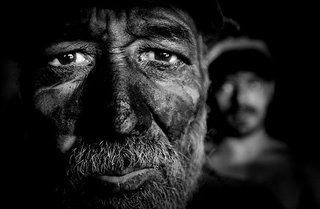
Yet I persist.
It's not really the toughest job I've ever held.
In fact, it would be fun if you all chimed in on this: What was your toughest job?
Here's a few to get you started...
Once, I worked overnight as a custodian at a childcare center on campus. It was generally pud, for I had all night to do 4 hours of work, and I had free reign of the facility...however, cleaning the kiddie urinals daily was unpleasant, and when they played in the sand, it was impossible to vacuum.
I can beat that, myself. I once (for a single day) worked at a feedlot (look it up, ye who know naught of them). I painted corral fencing, waded up to my knees in mud-n-manure. It was June, very hot, very humid, very...fragrant. The paint was oil-based. We were using wash mitts to apply it. The paint dried on my arms and 'had' to be removed with wire brush and gasoline (not too smart, to say the least).
Then there was the day I did preg-checks for an entire day, reaching the length of my arm into the privates of bovines...
Then, a couple of times, I've had to castrate cattle. The man I worked for let his little bullies get far too large (two years old, some of them) and thus, cutting horns and testicles was a gruesome, painful, nightmare for everyone involved.
Oh, almost forgot the manual labor experience that sent me packing to higher education: I was laying out a year before committing to college. I was undecided. Working in a glass shop, I found my motivation one spring day when several 4x8 sheets of plate glass smacked me like a bug when they were blown free of the delivery truck. Though not badly injured, (after all, I was 18 and invincible) I was suddenly aware that standing by a glass truck on a smoke break had nearly proven fatal.
I have been exposed to truly terrible work environments. I've watched the poor, hapless drones behind the fast food counter and within the kitchen. I've heard some horror stories from highway workers. I watched Clerks...
...and, in April of 2000, I had the chance to walk 3 miles in the boots of true coal miners in Mexico. We descended deep into a mine, so deep and oppressive it gave me the heebie jeebies just to be there. It was dark, humid, dusty in places...sometimes outright hot, as if we were drilling to the center of the earth. I expected a spurt of magma at any minute. When we came out later, I was so coated in black coal dust it took (truly!) days and days to get it all out of my pores. Now THAT was a nasty job, coal mining.
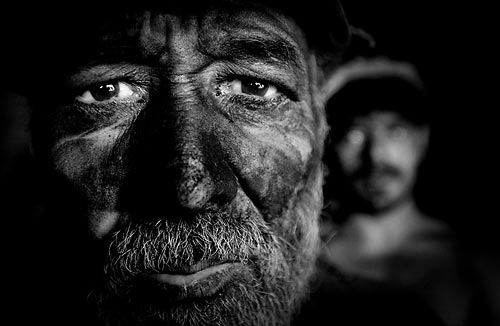
Yet I persist.
It's not really the toughest job I've ever held.
In fact, it would be fun if you all chimed in on this: What was your toughest job?
Here's a few to get you started...
Once, I worked overnight as a custodian at a childcare center on campus. It was generally pud, for I had all night to do 4 hours of work, and I had free reign of the facility...however, cleaning the kiddie urinals daily was unpleasant, and when they played in the sand, it was impossible to vacuum.
I can beat that, myself. I once (for a single day) worked at a feedlot (look it up, ye who know naught of them). I painted corral fencing, waded up to my knees in mud-n-manure. It was June, very hot, very humid, very...fragrant. The paint was oil-based. We were using wash mitts to apply it. The paint dried on my arms and 'had' to be removed with wire brush and gasoline (not too smart, to say the least).
Then there was the day I did preg-checks for an entire day, reaching the length of my arm into the privates of bovines...
Then, a couple of times, I've had to castrate cattle. The man I worked for let his little bullies get far too large (two years old, some of them) and thus, cutting horns and testicles was a gruesome, painful, nightmare for everyone involved.
Oh, almost forgot the manual labor experience that sent me packing to higher education: I was laying out a year before committing to college. I was undecided. Working in a glass shop, I found my motivation one spring day when several 4x8 sheets of plate glass smacked me like a bug when they were blown free of the delivery truck. Though not badly injured, (after all, I was 18 and invincible) I was suddenly aware that standing by a glass truck on a smoke break had nearly proven fatal.
I have been exposed to truly terrible work environments. I've watched the poor, hapless drones behind the fast food counter and within the kitchen. I've heard some horror stories from highway workers. I watched Clerks...
...and, in April of 2000, I had the chance to walk 3 miles in the boots of true coal miners in Mexico. We descended deep into a mine, so deep and oppressive it gave me the heebie jeebies just to be there. It was dark, humid, dusty in places...sometimes outright hot, as if we were drilling to the center of the earth. I expected a spurt of magma at any minute. When we came out later, I was so coated in black coal dust it took (truly!) days and days to get it all out of my pores. Now THAT was a nasty job, coal mining.
Thursday, November 30, 2006
Monday, November 27, 2006
More on Food
I just heard a radio broadcast on food waste...This takes you to the transcript of an interview of the same ilk. "Tim Jones is an anthropologist from the University of Arizona and he was on The Science Show two years ago, having found that households alone, in America alone, throw away $48.3 billion worth of food each year."
Gadzooks! Pass the potatoes.
Gadzooks! Pass the potatoes.
Friday, November 24, 2006
Food...for thought.
As most read this, they are recovering from Thanksgiving feeding frenzies. Some I know had three or four Thanksgiving dinners to devour. We waddle away from these more stuffed than the turkeys we consumed. It is the season in which the guilty pleasure of gorging is soon chased with the guilt-laden advertising of dieting programs, nationwide.
What better time to share some thoughts on food!
Recently, I served up a bowl of dry dog food for my beagle, Roger. Then, I turned my attention to my kids, and poured them some cereal. As everyone was munching away, I thought that every meal should be so simple. Pour it in a bowl and eat it, same thing, every meal, just like Roger.
It also reminded me of a time, as an evil big brother, that I served my little brother a bowl of chocolate puffs cereal. I was tired of serving him breakfast, and I had a bit of a mean streak, too. I waited until he had consumed a few spoonfuls before I told him it was rabbit droppings I’d picked up around the farm before he woke up. (I can only hope my boys won’t be so mean-spirited!) I don’t know the nutritional value of rabbit droppings. I don’t even know if one could put enough sugar on them to make them tasty. I suppose the practice might be environmentally sound, but I don’t suggest it.
What I might suggest, however, is simplifying our diet. This is totally contrary to my wife’s way of thinking. She feels guilty cooking a roast, for it’s too easy. She’s a great cook, inspired by dozens of cookbooks and hours of the food channel. Maybe her way of thinking, that it has to be unique or complicated, is the status quo these days. I know she’s trying to do her best by us, serving sautéed olive skins over braised lamb’s breath sprinkled with shavings of mango or whatever…but truly, it doesn’t have to be a production to be nutritious.
Reminder: I was a bachelor for the better part of twenty years. For me, peanut butter and jelly sandwiches were complicated. I often ate cereal for meals, right out of the box. A sack of potatoes offered me a week of meals. I was not one to shun prepared foods, either. I ate my weight in fast food weekly. I did not recognize food if it did not have to first be unwrapped and micro-waved. One of my greatest garage sale finds of all time was a case of military-issue Meals Ready to Eat (MRE’s). To my way of thinking, to this day, SPAM is the ultimate food product. (It is fun to carve into exotic shapes, too.)
Now, I grew up on a dirt farm, and we produced a great deal of grain. Back then, I thought it was only for livestock. I came to marvel at the annual Home Products Dinner held in my hometown, for they had baked bread from the grain of our ground. They had even made donuts out of sorghum. I learned all manner of corn and grain could be popped. When attending Kansas State University, I toured a facility that turned grain into cheese puffs. Finally, I truly understood: grain really was food!
Interestingly enough, I have since learned that most people on the planet live on a diet of grain products. It’s not just for livestock or cheese puffs. Even a review of the food pyramid suggests a healthy portion of breads, cereals, etc. While a diet exclusively grain-based may not be entirely healthy, it is at least more simple.
Of all the cookbooks in our kitchen, I most admire a couple published by the Mennonites, the “More with Less” series. Sensitive to global inequities in food availability and distribution, aware of the massive environmental footprint left by the diet of the northern hemisphere, rooted in the agrarian tradition of their faith, these ladies put together one heck of a cookbook. It features traditional meals, like those we just enjoyed, but it puts a focus on grain-heavy diets.
My wife and I go round-and-round about this. I say, let’s eat cracked wheat. She says, what about the children? I know it’s never going to go my way, that even if we did have cracked wheat, it would be sprinkled over something exotic. I wouldn’t even suggest a grain-heavy diet to anyone, let alone a vegetarian course. (Area ranchers would shoot me on sight.)
I would say, however, that after our annual pig out, maybe it would be okay to take it easy, to eat more simply. There are actually “movements” afoot to encourage us to slow down and eat whole meals at the kitchen table. One such activist group is Slow Food, USA. They argue that “industrialization of food was standardizing taste and leading to the annihilation of thousands of food varieties and flavors.” Who could argue with preserving food and flavor! They advocate gardening, farmer’s markets, less processed and more simple meals.
That all still seems like a lot of work, but I like the idea of slow food. If I were still a bachelor, I’d support the cause. I’d slowly masticate nothing but potatoes from New Year’s to Thanksgiving, then get my fill of all the good stuff.
What better time to share some thoughts on food!
Recently, I served up a bowl of dry dog food for my beagle, Roger. Then, I turned my attention to my kids, and poured them some cereal. As everyone was munching away, I thought that every meal should be so simple. Pour it in a bowl and eat it, same thing, every meal, just like Roger.
It also reminded me of a time, as an evil big brother, that I served my little brother a bowl of chocolate puffs cereal. I was tired of serving him breakfast, and I had a bit of a mean streak, too. I waited until he had consumed a few spoonfuls before I told him it was rabbit droppings I’d picked up around the farm before he woke up. (I can only hope my boys won’t be so mean-spirited!) I don’t know the nutritional value of rabbit droppings. I don’t even know if one could put enough sugar on them to make them tasty. I suppose the practice might be environmentally sound, but I don’t suggest it.
What I might suggest, however, is simplifying our diet. This is totally contrary to my wife’s way of thinking. She feels guilty cooking a roast, for it’s too easy. She’s a great cook, inspired by dozens of cookbooks and hours of the food channel. Maybe her way of thinking, that it has to be unique or complicated, is the status quo these days. I know she’s trying to do her best by us, serving sautéed olive skins over braised lamb’s breath sprinkled with shavings of mango or whatever…but truly, it doesn’t have to be a production to be nutritious.
Reminder: I was a bachelor for the better part of twenty years. For me, peanut butter and jelly sandwiches were complicated. I often ate cereal for meals, right out of the box. A sack of potatoes offered me a week of meals. I was not one to shun prepared foods, either. I ate my weight in fast food weekly. I did not recognize food if it did not have to first be unwrapped and micro-waved. One of my greatest garage sale finds of all time was a case of military-issue Meals Ready to Eat (MRE’s). To my way of thinking, to this day, SPAM is the ultimate food product. (It is fun to carve into exotic shapes, too.)
Now, I grew up on a dirt farm, and we produced a great deal of grain. Back then, I thought it was only for livestock. I came to marvel at the annual Home Products Dinner held in my hometown, for they had baked bread from the grain of our ground. They had even made donuts out of sorghum. I learned all manner of corn and grain could be popped. When attending Kansas State University, I toured a facility that turned grain into cheese puffs. Finally, I truly understood: grain really was food!
Interestingly enough, I have since learned that most people on the planet live on a diet of grain products. It’s not just for livestock or cheese puffs. Even a review of the food pyramid suggests a healthy portion of breads, cereals, etc. While a diet exclusively grain-based may not be entirely healthy, it is at least more simple.
Of all the cookbooks in our kitchen, I most admire a couple published by the Mennonites, the “More with Less” series. Sensitive to global inequities in food availability and distribution, aware of the massive environmental footprint left by the diet of the northern hemisphere, rooted in the agrarian tradition of their faith, these ladies put together one heck of a cookbook. It features traditional meals, like those we just enjoyed, but it puts a focus on grain-heavy diets.
My wife and I go round-and-round about this. I say, let’s eat cracked wheat. She says, what about the children? I know it’s never going to go my way, that even if we did have cracked wheat, it would be sprinkled over something exotic. I wouldn’t even suggest a grain-heavy diet to anyone, let alone a vegetarian course. (Area ranchers would shoot me on sight.)
I would say, however, that after our annual pig out, maybe it would be okay to take it easy, to eat more simply. There are actually “movements” afoot to encourage us to slow down and eat whole meals at the kitchen table. One such activist group is Slow Food, USA. They argue that “industrialization of food was standardizing taste and leading to the annihilation of thousands of food varieties and flavors.” Who could argue with preserving food and flavor! They advocate gardening, farmer’s markets, less processed and more simple meals.
That all still seems like a lot of work, but I like the idea of slow food. If I were still a bachelor, I’d support the cause. I’d slowly masticate nothing but potatoes from New Year’s to Thanksgiving, then get my fill of all the good stuff.
Monday, November 20, 2006
Mortality Morality
On this day, almost to the hour, three years ago...I had my last conversation with my dad. It wasn't an especially good conversation, for I was gruff. My parents had skipped my son's first birthday party the week previous, and I was in no mood to hear about western kansas, Agrigas meter service, snow over the door handles on the pickups, etc...I was in no mood to negotiate visiting over Thanksgiving at some hotel buffet again, either. I was cloudy, thinking how unlike the Cleavers we were, and how very much I wanted a Rockwellian holiday, just once.
Then, Wednesday morning at the same phone, a call came in. I was the only one on campus, it was a fluke that the phone would even ring on the holiday break. Out of curiosity, I picked up, only to talk to someone from the Ulysses PD, who shared the bad news: my dad had died in his sleep.
I think that was the moment, more than any before/since, that I wished I could control time, that I could TIVO back just two days and have that conversation all over again. Sure, we said the perfunctory "Love 'ya" as always. Sure, he didn't likely even know I was unhappy with him...but if I could re-do that conversation, it would be so very different.
Of course, that is just a fantasy. The reality is that in life there are no do-overs. That one change, my dad's passing, has likely affected me more than any other single event in my timeline. More than getting married. More than having kids. More than flunking out of college. More than asking my best friend to shoot me with a .30 caliber rifle when wearing a kevlar vest....Since that one event, my career changed twice, my residence changed three times, and my outlook has never quite quit revolving around the presence of the present. (For that matter, the present [gift] of the present.)
Sometimes I forget, like everyone else, and just take time and life for granted. There are moments which pass that I still reflect on with regret. For the most part, however, I try to now live as if this moment, these people, this presence, may never recur. Days like this, milestones like headstones, remind me.
I'll never quite know if my dad saw it coming. He was in good health, had quit smoking and he was exercising daily. He'd had a full physical just a month before, and he'd passed with flying colors. Somehow, however, tracking back through his notes, journals, files, etc...I think he was privvy to the reaper's knock. He had become somewhat obsessed with the idea of not only capturing family geneology, but also family history, particularly stories. He had commissioned my wife and I to gather up all the Jarvis family anecdotes by video and audio, and to then link them to 'fruits' hanging from the family tree. Sadly, that idea has not gone past his dream of it...but it suggests that he, at least, understood mortality and wanted to preserve a little something.
I tried following in his footsteps. I even moved back to Western Kansas and took over his estate, his business, and the care of his wife, dogs, property, bills, etc. I was so resolute in that effort that I bought a house there before I even had quit my job back at Cowley.
I learned that wasn't really healthy for me. I'm not him. I don't like it out there, and I didn't like his business. I wanted to preserve the farmstead that had been my father's and his father's before him...but it's just not the same, anyway.
Now, I have a good life, and I'm a much different person than I was 3 years ago. I'd like to show him around the farm I own, set a grandkid on his knee, swap stories, tell lies...and in my head and heart, I suppose I do.
Then, Wednesday morning at the same phone, a call came in. I was the only one on campus, it was a fluke that the phone would even ring on the holiday break. Out of curiosity, I picked up, only to talk to someone from the Ulysses PD, who shared the bad news: my dad had died in his sleep.
I think that was the moment, more than any before/since, that I wished I could control time, that I could TIVO back just two days and have that conversation all over again. Sure, we said the perfunctory "Love 'ya" as always. Sure, he didn't likely even know I was unhappy with him...but if I could re-do that conversation, it would be so very different.
Of course, that is just a fantasy. The reality is that in life there are no do-overs. That one change, my dad's passing, has likely affected me more than any other single event in my timeline. More than getting married. More than having kids. More than flunking out of college. More than asking my best friend to shoot me with a .30 caliber rifle when wearing a kevlar vest....Since that one event, my career changed twice, my residence changed three times, and my outlook has never quite quit revolving around the presence of the present. (For that matter, the present [gift] of the present.)
Sometimes I forget, like everyone else, and just take time and life for granted. There are moments which pass that I still reflect on with regret. For the most part, however, I try to now live as if this moment, these people, this presence, may never recur. Days like this, milestones like headstones, remind me.
I'll never quite know if my dad saw it coming. He was in good health, had quit smoking and he was exercising daily. He'd had a full physical just a month before, and he'd passed with flying colors. Somehow, however, tracking back through his notes, journals, files, etc...I think he was privvy to the reaper's knock. He had become somewhat obsessed with the idea of not only capturing family geneology, but also family history, particularly stories. He had commissioned my wife and I to gather up all the Jarvis family anecdotes by video and audio, and to then link them to 'fruits' hanging from the family tree. Sadly, that idea has not gone past his dream of it...but it suggests that he, at least, understood mortality and wanted to preserve a little something.
I tried following in his footsteps. I even moved back to Western Kansas and took over his estate, his business, and the care of his wife, dogs, property, bills, etc. I was so resolute in that effort that I bought a house there before I even had quit my job back at Cowley.
I learned that wasn't really healthy for me. I'm not him. I don't like it out there, and I didn't like his business. I wanted to preserve the farmstead that had been my father's and his father's before him...but it's just not the same, anyway.
Now, I have a good life, and I'm a much different person than I was 3 years ago. I'd like to show him around the farm I own, set a grandkid on his knee, swap stories, tell lies...and in my head and heart, I suppose I do.
Thursday, November 16, 2006
Personal Responsibility
"Personal responsibility" seems a rare breed, an endangered species. The phrase is composed of two words I used to put in contrast: "personal" for me, was my business; "responsibility" was just an obscenity, so far as I was concerned, for it implied some degree of potential blame...and maturity, ownership, and accountability to Others. Until recently, I would flee from responsibility if ever I could, only accepting it to whatever degree I absolutely had to in order to function in civilization.
That was my take on it. Then I became a parent, and apparently, that changed everything. Now I own-up to being responsible. I know my kids will succeed to the degree I equip them. I know I must earn a living and be accountable (you know, keep office hours, pay taxes, eat regularly, etc) when before I fashioned myself as something of an outlaw misfit doing my own thing. From what I've been observing of others since my change in character and perspective, I'm not so convinced that even parenthood endues everyone with personal responsibility.
I've written before about frivolous lawsuits and the litigious nature of our culture. I've come to agree with conservatives like Glenn Beck on at least this one issue: people don't take responsibility for anything. Does there need to be a warning label on a bag of marshmallows that tells us not to eat the whole bag? Does a bar tender bear the burden of responsibility for someone drinking him- or herself silly? Should McDonald's be held liable for some dunce spilling hot coffee on herself?
I am on this topic at this time in the term for I know what is about to happen: whining. Students who have not, say, bothered to come to class regularly are all-the-sudden conscientious, studious, respectful (Eddie Haskells) and pleading for some extra credit, some reconsideration, some break. Later, a few who are issued a grade they don't particularly like will contest it through official channels, insisting it was not what they earned. (This seldom happens in my classes, but it isn't uncommon on a campus.) All too often, I have yielded, negotiated, and in many ways compromised. Not that I've compromised with the student, but I've compromised my standards.
Of this, I say, no more. (There, it's documented here for me to reflect over later.) Just when did school come to be the place to teach wiley negotiation, anyway? For that matter, is it even our responsibility to teach responsibility? Shouldn't it simply be expected, like it should be in the workforce? I have a feeling that low expectations, all-around, have created this lack of responsibility.
When I was in college, if I did not show up, I knew I was a *uck up, and I took what came my way. Sure, that caused something of a checkered transcript, and I did retake about $6,000 worth of courses, but that was my fault. I was the one who decided to skip, not do homework, refuse to dissect something, sleep in, go to the lake...drop out. I had a choice, I was paying the bills, and I bore the brunt of what I had decided to do.
When I taught technical writing, I had absolutely no mercy. I was supposedly training would-be engineers on workplace expectations. I led the class like an employer. Expectations were high, and achievement was equally high. (Of course, they were on their last semester of a Bachelor's degree and already contracting for jobs that paid several times what I earned, so they had extrinsic motivation!)
That may not work for me here at the community college (note, I did not say Juco!) Instead, I have a new plan to implement: zero tolerance for absences, absolutely no late work, and absolutely no extra credit. I'll keep the policy that work can be submitted in advance of known absences and that anticipated absences (or absences excused by the institution) can be dealt with in advance. I'll have some kind of 'personal hardship' clause, to compensate for sudden deaths among family, etc. Otherwise, I'll front everyone a set amount of points (resembling sick leave). If they expend those points on material not submitted, etc. then it's gone. If, come the end of the term, enough of those points remain in their 'account' then they do not have to take my final exam. (Truth is, that's still extra credit, underneath it all, but it's going to save me an enormous amount of bookwork.)
Maybe that will thwart the whiners next semester.
Back to reality, outside the ivy walls of academia...personal responsibility is a bitter pill, a big burden. No wonder so very many people are repelled by it. By contrast, it seems so much easier to blame others, to litigate against others, to milk some corporate cash cow. The effects of this are far reaching, and all too often, these effects are reaching into my pocket (and no, it doesn't tickle). Medical and insurance rates are high, taxes go higher, and sometimes simple fear is stratospheric. For example, some schools no longer go on field trips. Some churches no longer do 'high risk' fundraisers like car washes. Even teachers must fear the litigious reaper--'heard of "academic negligence" or "educational malpractice" yet? If not, you will!
Just today, an employee of a major toy company told us of a situation I found incredulous. She works a customer complaint line. Someone called her, raised hell with her, for the caller had cut himself when attempting to open her company's toy. (To this point, I could sympathize with the caller, for I spent last weekend struggling with wires and tabs and bangles and what's-it's, just to remove my son's toys from their cartons.) He threatened, then, to sue her company. Result? the policy is that her company is to make every conciliatory effort to appease the customer. Her company paid damages, his medical bills, and something of an out-of-court settlement for the grievous affect the whole affair plagued him with.
Here's the kicker: that man had been opening said toy boxes with a steak knife. There was not warning on the box, he had said, that suggested he might use, say, a nail file or pen knife. Nothing warning him that steak knives, meat cleavers, chain saws or blow torches might endanger him, should he consider using them to open said box.
(Apologies to Genesis): This is the world we live in. This is the hand we're given (unless say, we cut it off with a wild steak knife). I say it's high time we start trying to make it a world worth living in. Maybe the first step is to own up to our own screw ups.
It's a personal goal. It's an instructional goal to impart on my students. It's a goal I have in parenting, too. Already, I tell my kid, "Hey, you have the choice here, pal. You can poop your pants and clean it up, or you can be a big boy and use the stool." If he's figuring it out, maybe everyone else can, too. (?)
That was my take on it. Then I became a parent, and apparently, that changed everything. Now I own-up to being responsible. I know my kids will succeed to the degree I equip them. I know I must earn a living and be accountable (you know, keep office hours, pay taxes, eat regularly, etc) when before I fashioned myself as something of an outlaw misfit doing my own thing. From what I've been observing of others since my change in character and perspective, I'm not so convinced that even parenthood endues everyone with personal responsibility.
I've written before about frivolous lawsuits and the litigious nature of our culture. I've come to agree with conservatives like Glenn Beck on at least this one issue: people don't take responsibility for anything. Does there need to be a warning label on a bag of marshmallows that tells us not to eat the whole bag? Does a bar tender bear the burden of responsibility for someone drinking him- or herself silly? Should McDonald's be held liable for some dunce spilling hot coffee on herself?
I am on this topic at this time in the term for I know what is about to happen: whining. Students who have not, say, bothered to come to class regularly are all-the-sudden conscientious, studious, respectful (Eddie Haskells) and pleading for some extra credit, some reconsideration, some break. Later, a few who are issued a grade they don't particularly like will contest it through official channels, insisting it was not what they earned. (This seldom happens in my classes, but it isn't uncommon on a campus.) All too often, I have yielded, negotiated, and in many ways compromised. Not that I've compromised with the student, but I've compromised my standards.
Of this, I say, no more. (There, it's documented here for me to reflect over later.) Just when did school come to be the place to teach wiley negotiation, anyway? For that matter, is it even our responsibility to teach responsibility? Shouldn't it simply be expected, like it should be in the workforce? I have a feeling that low expectations, all-around, have created this lack of responsibility.
When I was in college, if I did not show up, I knew I was a *uck up, and I took what came my way. Sure, that caused something of a checkered transcript, and I did retake about $6,000 worth of courses, but that was my fault. I was the one who decided to skip, not do homework, refuse to dissect something, sleep in, go to the lake...drop out. I had a choice, I was paying the bills, and I bore the brunt of what I had decided to do.
When I taught technical writing, I had absolutely no mercy. I was supposedly training would-be engineers on workplace expectations. I led the class like an employer. Expectations were high, and achievement was equally high. (Of course, they were on their last semester of a Bachelor's degree and already contracting for jobs that paid several times what I earned, so they had extrinsic motivation!)
That may not work for me here at the community college (note, I did not say Juco!) Instead, I have a new plan to implement: zero tolerance for absences, absolutely no late work, and absolutely no extra credit. I'll keep the policy that work can be submitted in advance of known absences and that anticipated absences (or absences excused by the institution) can be dealt with in advance. I'll have some kind of 'personal hardship' clause, to compensate for sudden deaths among family, etc. Otherwise, I'll front everyone a set amount of points (resembling sick leave). If they expend those points on material not submitted, etc. then it's gone. If, come the end of the term, enough of those points remain in their 'account' then they do not have to take my final exam. (Truth is, that's still extra credit, underneath it all, but it's going to save me an enormous amount of bookwork.)
Maybe that will thwart the whiners next semester.
Back to reality, outside the ivy walls of academia...personal responsibility is a bitter pill, a big burden. No wonder so very many people are repelled by it. By contrast, it seems so much easier to blame others, to litigate against others, to milk some corporate cash cow. The effects of this are far reaching, and all too often, these effects are reaching into my pocket (and no, it doesn't tickle). Medical and insurance rates are high, taxes go higher, and sometimes simple fear is stratospheric. For example, some schools no longer go on field trips. Some churches no longer do 'high risk' fundraisers like car washes. Even teachers must fear the litigious reaper--'heard of "academic negligence" or "educational malpractice" yet? If not, you will!
Just today, an employee of a major toy company told us of a situation I found incredulous. She works a customer complaint line. Someone called her, raised hell with her, for the caller had cut himself when attempting to open her company's toy. (To this point, I could sympathize with the caller, for I spent last weekend struggling with wires and tabs and bangles and what's-it's, just to remove my son's toys from their cartons.) He threatened, then, to sue her company. Result? the policy is that her company is to make every conciliatory effort to appease the customer. Her company paid damages, his medical bills, and something of an out-of-court settlement for the grievous affect the whole affair plagued him with.
Here's the kicker: that man had been opening said toy boxes with a steak knife. There was not warning on the box, he had said, that suggested he might use, say, a nail file or pen knife. Nothing warning him that steak knives, meat cleavers, chain saws or blow torches might endanger him, should he consider using them to open said box.
(Apologies to Genesis): This is the world we live in. This is the hand we're given (unless say, we cut it off with a wild steak knife). I say it's high time we start trying to make it a world worth living in. Maybe the first step is to own up to our own screw ups.
It's a personal goal. It's an instructional goal to impart on my students. It's a goal I have in parenting, too. Already, I tell my kid, "Hey, you have the choice here, pal. You can poop your pants and clean it up, or you can be a big boy and use the stool." If he's figuring it out, maybe everyone else can, too. (?)
Tuesday, November 14, 2006
Let the Devil in the Door
Another parenting threshold stumbled over--this time: video games. Yes, my 4 year old was given a video game for his birthday last weekend. No hard feelings, cousins who gifted him with this, but you must know (should you ever read this blog) that I am mortified.

Will this some day be my child's fate?
I know not all gamers are geeks (or worse). I know that many have avid gaming interests and are still interactive, socially conscious human beings. I also know, however, too much about the industry, the dark side, the evil-doers!
Even at the most fundamental, gaming can rob a family of togetherness, and I treasure that very highly. So, we had our first 'family meeting' last night. I explained to mom and the 1 and 4 yr olds that I had, admittedly, lost the battle on the abuse of television in my household. I had, in addition, contributed to other infringements on our time together. However, I firmly asserted, with plugging in this video game, there would be some rules: 1)Never play alone 2)Never play more than 30 minutes a day. Well, we'll see how it goes. I just wanted to document here that I had made some effort to stop what I anticipate will be a tidal flow of media influence and infringement in our home. There, I tried.

Will this some day be my child's fate?
I know not all gamers are geeks (or worse). I know that many have avid gaming interests and are still interactive, socially conscious human beings. I also know, however, too much about the industry, the dark side, the evil-doers!
Even at the most fundamental, gaming can rob a family of togetherness, and I treasure that very highly. So, we had our first 'family meeting' last night. I explained to mom and the 1 and 4 yr olds that I had, admittedly, lost the battle on the abuse of television in my household. I had, in addition, contributed to other infringements on our time together. However, I firmly asserted, with plugging in this video game, there would be some rules: 1)Never play alone 2)Never play more than 30 minutes a day. Well, we'll see how it goes. I just wanted to document here that I had made some effort to stop what I anticipate will be a tidal flow of media influence and infringement in our home. There, I tried.
Subscribe to:
Posts (Atom)

